About this job
What does installing outdoor lighting involve?
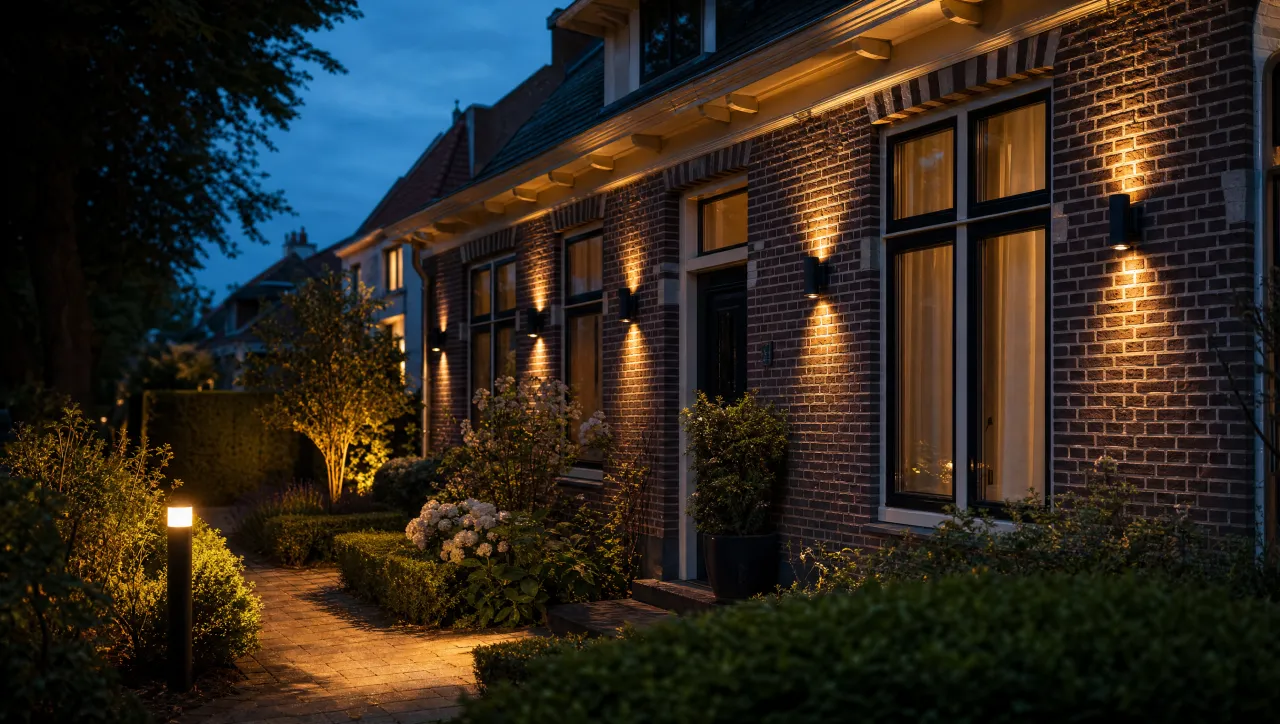
Installing outdoor lighting means designing and fitting a weather-resistant, earthed installation in the outdoor space. Think garden, driveway and wall lighting, outdoor sockets and their control via a motion sensor or dusk switch. It starts with a good plan: we agree in advance where the light points, socket points, sensors and cable routes will go. The same work is also known as garden lighting installation.
There are two common systems. Low voltage at 12 or 24 volts (SELV) works via a transformer and is safe and flexible, popular for garden and pond lighting and ground spots. For wall lights, outdoor sockets, driveway lighting and heavier loads you need 230 V mains power, with an underground cable in the garden. In practice we often combine both systems in one garden.
Warning signs
When should you have outdoor or garden lighting installed?
Do you recognise any of these situations? Then it is a good moment to have your outdoor installation fitted safely and neatly.
New garden, driveway or terrace
A new garden, driveway, veranda, outdoor kitchen or garden shed with no power or light. We install the light points and socket points exactly where you want them.
Safety and visibility around the house
Lit pathways, driveway lighting and motion-controlled light at the front door and back entrance. Good for visibility and to deter unwanted visitors.
Too few outdoor sockets
Running an extension lead from inside to outside? That is unsafe and not weather-resistant. A fixed outdoor socket (splash-proof) solves that.
No separate circuit or RCD
An existing outdoor installation without a dedicated circuit or without 30 mA RCD protection, we bring neatly up to standard.
How we work
How we install your outdoor lighting
From the initial lighting plan to handover: clear, safe and to NEN 1010.
- 1
Lighting plan and survey
We draw up a plan with the light points, socket points, sensors, transformers and cable routes. We choose 12 or 24 V or 230 V per zone. Then a fixed price upfront.
- 2
Excavating and laying the cable
We lay the underground cable at the correct depth: approximately 50 to 60 cm in the garden and approximately 1 metre under a driveway, with warning tape and a protective conduit where needed.
- 3
Meter cabinet and connection
Where necessary we fit a dedicated circuit with a 30 mA RCD and connect the fittings, outdoor sockets, sensors and transformer.
- 4
Testing and handover
We carry out an RCD test and measure the installation, checking the IP rating and zones near water. We then hand over neatly, with a 2-year work guarantee.
Good to know
The technical side, in plain English
A few choices that often raise questions with outdoor lighting. We explain them calmly.
12 volt or 230 volt outdoor lighting: which is better?
Low voltage at 12 or 24 volts (SELV) is safe and flexible. It works via a transformer and is popular for garden and pond lighting and ground spots. Because the voltage is low, the requirements on the cable are less strict, making it easy to add a light point later.
230 V mains power is needed for wall lights, outdoor sockets, driveway lighting and heavier loads. This runs via an underground cable in the garden. In practice we often combine both: 230 V to the wall and the sockets, and 12 V for the ambient and ground lighting in the borders.
How deep does the underground cable go?
For 230 V in the garden we use armoured underground cable, usually YMvK-as, for example 3x2.5 mm² for a standard circuit. For long distances or multiple switch wires we deliberately choose a heavier cross-section to prevent voltage drop.
The depth is important: reckon on approximately 50 to 60 cm in the garden and approximately 1 metre under a driveway or paved surface. Above the cable we lay warning tape (approximately 20 cm above it) and a protective conduit in vulnerable spots. That keeps the cable safe even when digging happens later.
Motion sensor, dusk switch or smart control
A PIR motion sensor switches on movement (heat) and is ideal at entrances, driveways and paths. A dusk switch responds to ambient light and turns garden or wall lighting on automatically at nightfall, with an adjustable lux setting. Both work well combined in a single fitting.
For more control, we link the lighting to a smart system (home automation) for switching, dimming and time control. This becomes particularly useful from 2027: once the net-metering scheme ends, smart switching will help you make better use of your own solar power during the day.
Which IP rating do you need outdoors?
The IP rating shows how well a fitting or socket is protected against dust and water. Choose the right rating for each location outdoors.
| IP rating | Suitable for |
|---|---|
| IP44 | Minimum for garden lighting and outdoor sockets, splash-proof |
| IP65 | Wet and demanding locations, jet-proof in heavy rainfall |
| IP67 / IP68 | Ground spots and underwater fittings, for ponds or swimming pools |
The first digit stands for dust, the second for water. For ponds and swimming pools a zone layout applies to NEN 1010: in the wettest zones low voltage only (12 or 24 volt).
Price
What does outdoor lighting installation cost?
The price depends on the number of light points and sockets, the metres of underground cable and the excavation work, the choice between 12 and 230 V, the IP rating of the fittings and whether a dedicated circuit is needed. That is why we look first, then give you a fixed price upfront. Below is an indication.
Common extras:
- Motion sensor or dusk switch per fitting
- Transformer for 12 V low voltage
- Extra excavation through paving or a driveway
- Ground spots with a high IP rating (IP67 or IP68)
Price guide
Fixed price upfront| Outdoor lighting per light point | € 100 to € 300 |
| Outdoor socket (per point) | € 100 to € 250 |
| Underground cable (per metre) | € 10 to € 20 |
| Adding a circuit | € 120 to € 280 |
| Connecting a 30 mA RCD | € 115 to € 175 |
| Electrician's hourly rate (excl. VAT) | € 45 to € 70 |
Indicative prices incl. VAT. You will always receive a tailored quote.
Related services
Often done together
Outdoor lighting often goes hand in hand with these jobs. We are happy to help you work it out.
Socket and switch
A splash-proof outdoor socket for the driveway, terrace or garden. Neatly and weather-resistantly connected.
More infoHome automation
Smart switching, dimming and time control? We link your outdoor lighting to a smart system such as Philips Hue.
More infoAdd a circuit
A dedicated circuit for the garden, with a 30 mA RCD. Safe, tidy and ready to expand.
More infoElectrical installation
Need wiring, circuits or connections indoors too? We install your electrics professionally to NEN 1010.
More infoWhy Brabant Elektra
Certified, insured and guaranteed
All our engineers are qualified and work to the NEN 1010 standard. We give a 2-year guarantee on all our work. Reliable work you can count on.

Frequently asked questions
Good to know
Service area
Outdoor lighting installation in Noord-Brabant
We install outdoor and garden lighting throughout Noord-Brabant, from new-build gardens in the city to driveways and farmyards in the countryside. Every garden is different, so we always look on site first at the cable routes, the distance to the meter cabinet and the ground conditions, whether that is grass, paving or a driveway.
Outdoor lighting alone rarely requires a heavier mains connection. If you are also adding an EV charger or heat pump at the same time, an upgrade via grid operator Enexis may be needed. Since 1 July 2026, grid operators in congestion areas work with an integrated waiting list, so we apply in good time on your behalf.
Service area
Across Noord-Brabant
From major cities to smaller towns, active in:
Ready to have this job done professionally?
Request a free quote or call an electrician near you directly. You will always get a fixed price upfront.
Request a free quote
Response within 24 hours · no obligation
Step 1 of 3
Emergency? Call now
For emergencies, calling is the quickest way to get help. A technician is ready for you.
Call 085 - 060 12 34Thank you, request received!
We will call you back within 24 hours.