About this job
What are bathroom electrics, and what do the safety zones mean?
Bathroom electrics means installing or renewing the electrical installation in a wet room safely. Because water and skin greatly reduce your body's resistance, stricter rules apply here than in a dry room. The key is layered protection: a system of safety zones, splash-proof materials (the IP rating), safe low voltage in the wettest areas, a 30 mA RCD on every bathroom circuit, and equipotential bonding connecting all metal parts at the same potential.
These requirements are set out in NEN 1010, chapter 701 on bathroom spaces. In short, the standard divides the bathroom into zones around the bath, shower and washbasin. The closer to the water, the stricter the requirements on materials. We determine which zone applies to each spot, which IP rating is needed and where a socket or switch is and is not permitted. That way your bathroom will be safe for years to come.
Warning signs
When should bathroom electrics be installed or updated?
A new bathroom or an outdated installation is often the trigger. If you recognise any of these situations, have your installation checked.
Bathroom renovation or new bathroom
New lighting, a lit mirror, ventilation or underfloor heating. The ideal moment to install the electrics to the correct zones and NEN 1010 from the start.
No separate RCD on the bathroom circuit
An old installation without a 30 mA RCD on the bathroom circuit is a direct safety risk and no longer meets the standard. This needs to be sorted without delay.
Socket or switch too close to the water
Within 60 cm of the bath, shower or washbasin tap there should be no ordinary socket. Missing equipotential bonding on metal pipes or a radiator is also a warning sign.
The RCD keeps tripping
An RCD that trips repeatedly in the bathroom can indicate moisture in an old installation. Have the cause traced before something more serious happens.
How we work
How we approach bathroom electrics
From design to handover we work to NEN 1010. You know in advance what will happen and what it will cost.
- 1
Design and zone layout
We map out the zones, determine the IP rating for each component, plan a separate bathroom circuit with an RCD, and establish the position of the central earth point and bonding.
- 2
Installation
We use halogen-free conduit and splash-proof junction and ceiling boxes, mount the earth point in a dry accessible location, and connect fittings, the mirror and the heating safely.
- 3
Safe to the zones
Every bathroom circuit behind a 30 mA RCD, safe low voltage in the wettest areas, and all metal parts in the equipotential bonding. Correct in every detail.
- 4
Testing and handover
We measure insulation resistance, earthing, disconnection time and RCD performance to Scope 10 and record everything in a handover report with a NEN 1010 declaration.
Good to know
The safety zones and IP ratings in the bathroom
The bathroom is divided into zones around the water. Each zone has a minimum IP rating: the closer to the bath or shower, the stricter. This tells you exactly what is permitted where.
What do zones 0, 1 and 2 mean?
Zone 0 is inside the bath tub or shower tray, or up to 10 cm above a tiled shower floor. Only fixed appliances that the manufacturer explicitly releases for zone 0 are permitted here, fed on safe low voltage (maximum 12 V AC or 30 V DC) and at least IPX7, capable of withstanding submersion. No sockets, no switches.
Zone 1 is the area above that up to 2.25 m height. At least IPX4 (splash-proof), IPX5 where subject to direct water jets. Fixed equipment only, with a strong preference for 12 V lighting. Zone 2 is a radius of 60 cm around the edge of the bath or shower, plus 60 cm around the washbasin tap, up to 2.25 m height, also at least IPX4. With a walk-in shower without a tray, zone 2 is removed and zone 1 extends to a radius of 120 cm around the shower head.
Outside the zones the normal room requirements of NEN 1010 apply. Earthed, splash-proof 230 V sockets and switches are permitted there, provided they are behind a 30 mA RCD. Note: the current NEN 1010 no longer includes zone 3; older websites still use that term.
Socket, mirror, ventilation and heating
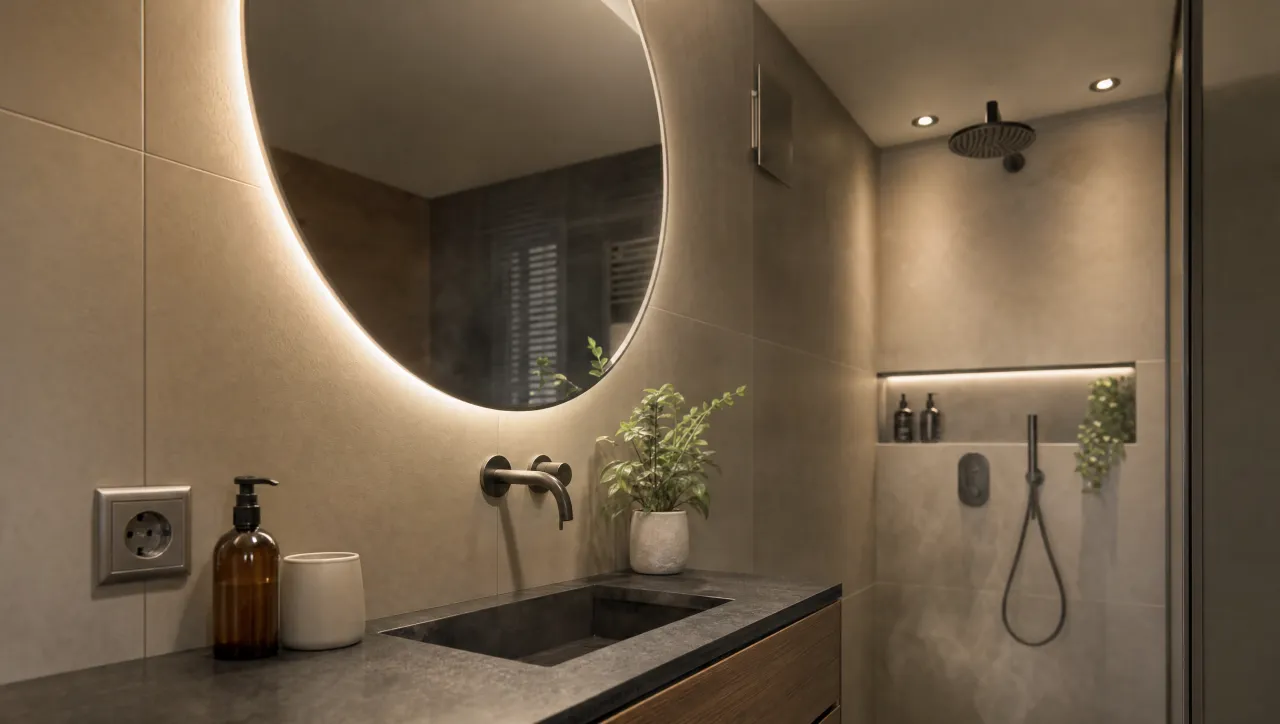
A useful rule of thumb: a socket should be at least 60 cm from the bath, shower and washbasin tap and at least 25 cm above the floor, splash-proof and earthed. A lit or heated mirror is not permitted in zone 0; it is usually 230 V outside zone 1 or in zone 2 with the correct IP rating, behind a 30 mA RCD and with metal parts in the bonding.
For lighting, IPX7 applies in the bath or shower, IPX4 (sometimes IPX5) in zones 1 and 2, and IP44 or higher outside those zones, preferably class II. A fan in zone 1 or 2 is at least IPX4 and is behind an RCD, with the switch preferably outside zone 2. Electric underfloor heating is a fixed appliance behind a 30 mA RCD, with the metal mat always connected to the central earth point.
IP rating per zone in the bathroom
Each zone has a minimum degree of protection against moisture. This table gives the rule of thumb; we determine the correct rating for each component.
| Zone | Where | Minimum IP rating | What is permitted |
|---|---|---|---|
| Zone 0 | Inside the bath or shower tray, up to 10 cm above the shower floor | IPX7 | Fixed appliance on safe low voltage only (12 V AC / 30 V DC) |
| Zone 1 | Above zone 0 up to 2.25 m height | IPX4 (IPX5 with water jets) | Fixed equipment, preferably 12 V lighting, no 230 V socket |
| Zone 2 | 60 cm around the bath, shower and washbasin tap, up to 2.25 m | IPX4 | Splash-proof lighting and ventilation, no ordinary socket |
| Outside the zones | Rest of the bathroom | IP44 recommended | Earthed splash-proof socket and switch, behind a 30 mA RCD |
With a walk-in shower without a tray, zone 2 is removed and zone 1 extends to 120 cm around the shower head. Indicative; always determined individually to NEN 1010.
Price
What does bathroom electrics cost?
Individual items are straightforward; a complete bathroom depends on the number of points and whether the conduit is already in place. The figures below are indicative. You always receive a fixed price upfront via a tailored quote.
Common extras:
- Electric underfloor heating: approximately € 25 to € 50 per m² investment
- Complete bathroom with underfloor heating, ventilation and premium lighting: often € 500 to € 2,000
- Reduced VAT rate of 9% on labour often applies to renovation of homes more than two years old
Price guide
Fixed price upfront| Fitting a splash-proof socket | € 75 to € 150 |
| Light switch or pull-cord switch | € 50 to € 100 |
| Recessed spotlight (per unit) | € 40 to € 80 |
| Connecting mirror lighting | € 100 to € 300 |
| Adding an RCD to the fuse box | € 150 to € 250 |
| Complete bathroom electrics | € 300 to € 1,000 |
Indicative prices incl. VAT. You will always receive a tailored quote.
Related services
Useful to look at too
Bathroom electrics often goes hand in hand with work on the fuse box, the wiring or the sockets. These pages complement it well.
Socket and switch
Where a socket is and is not permitted in the bathroom, and which splash-proof type you need.
More infoElectrical installation
New circuits, wiring and a separate bathroom circuit when the installation grows.
More infoReplace the fuse box
If a 30 mA RCD is missing or the box is full, we replace it safely to NEN 1010.
More infoAdd a circuit
A dedicated circuit for the bathroom, underfloor heating or ventilation, so your installation is not overloaded.
More infoWhy Brabant Elektra
Certified, insured and guaranteed
All our engineers are qualified and work to the NEN 1010 standard. We give a 2-year guarantee on all our work. Reliable work you can count on.

Frequently asked questions
Good to know
Service area
Bathroom electrics in Noord-Brabant
We work throughout Noord-Brabant, from new-build bathrooms in the city to renovations in the countryside. Every home is slightly different: one meter cabinet still has room for a separate bathroom circuit, another needs a little work on the fuse box first. We check what your situation needs before we start.
If heavy electric heating requires a heavier mains connection, we take into account the grid operator Enexis. Since 1 July 2026, households in busy areas are also subject to the waiting list for grid capacity, so those who apply in good time are seen sooner. We take care of that too, without any surprises.
Service area
Across Noord-Brabant
From major cities to smaller towns, active in:
Ready to have this job done professionally?
Request a free quote or call an electrician near you directly. You will always get a fixed price upfront.
Request a free quote
Response within 24 hours · no obligation
Step 1 of 3
Emergency? Call now
For emergencies, calling is the quickest way to get help. A technician is ready for you.
Call 085 - 060 12 34Thank you, request received!
We will call you back within 24 hours.