About this job
What does an electrical installation involve, and how does it work?
Installing electrics means building the complete installation: all wiring from the meter cabinet and fuse box to every endpoint, from socket and light point to a fixed connection for appliances. The installation is divided into final circuits, each protected by a circuit breaker, typically 16 A. Heavy loads above approximately 2,000 watts, such as an induction hob, washing machine and dryer, get their own dedicated circuit. Every connection point is earthed, and the circuits are protected by 30 mA RCDs.
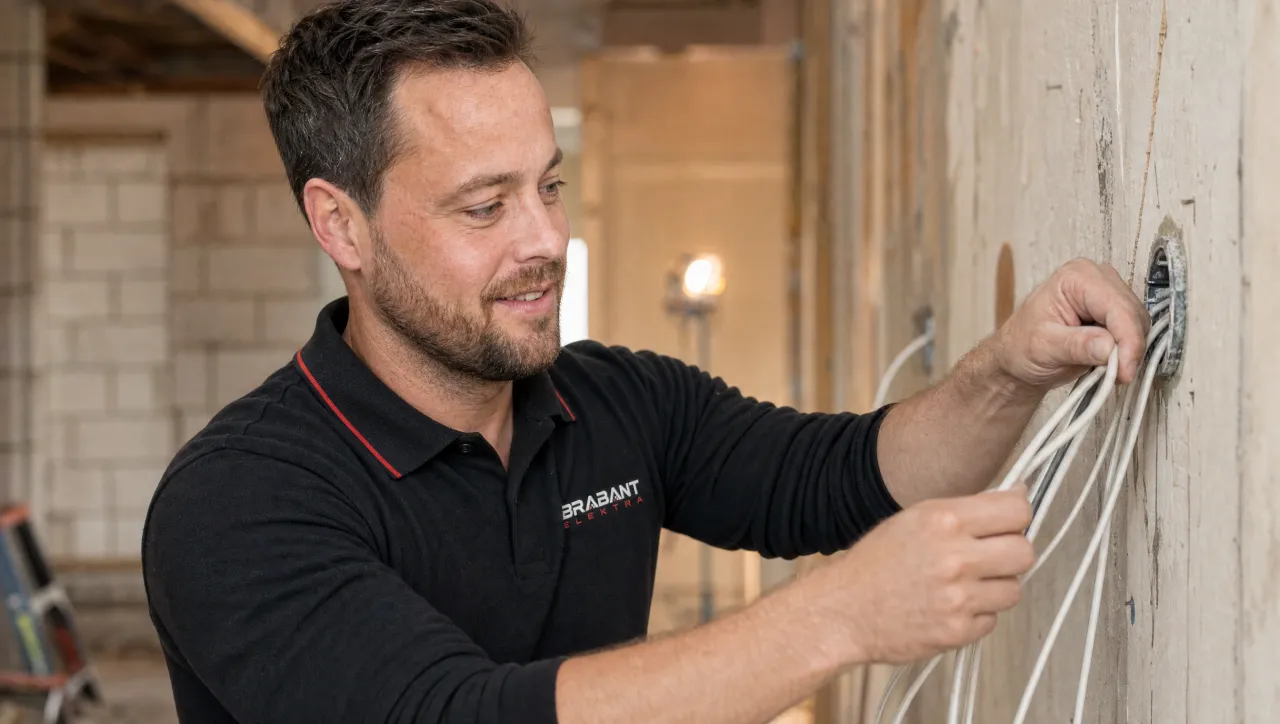
The sequence of work in brief: first a design and circuit plan, then the first-fix work of cutting or chasing channels and fitting conduit and back boxes, followed by pulling the wire through the conduit, connecting in the fuse box and at the endpoints, fitting the sockets and switches, and finally measuring, testing and signing off to NEN 1010. We handle the whole process and hand over neatly and safely.
Warning signs
When do you need a new electrical installation?
Installing everything new or largely new mainly arises when building, renovating or with outdated installations. If you recognise any of these situations, we are happy to help.
New build, extension or addition
There is no installation yet. We install everything from the meter cabinet up, neatly phased with the build, from first-fix to handover.
Major renovation or refurbishment
Are the walls and floors open anyway? That is the moment to renew the wiring while the chasing work is minimal.
Outdated or unsafe installation
No or too few RCDs, missing earthing, old fabric or rubber wiring, or too few circuits. In that case, renewal is the sensible choice.
Too few sockets
Lots of extension leads and adaptor blocks? That points to too few circuits and connection points. When we install, we sort that out straight away.
Old meter cabinet with ceramic fuses
A cabinet with ceramic fuses instead of circuit breakers, without an RCD, needs replacing. Often together with the wiring.
More power needed
Induction cooking, an EV charger, a heat pump or solar panels need extra circuits and sometimes three-phase. Include that while the walls are open.
How we work
How we approach it
From design to handover: clear, safe and to NEN 1010. We keep control, so you know in advance what to expect.
- 1
Design and circuit plan
We look at the space and your wishes and draw up a tailored circuit plan: where the points go, how many circuits are needed and whether an upgrade is required.
- 2
Conduit work and first-fix
We cut or chase the channels, fit the conduit and back boxes and pull the installation wire. Where channels cannot be cut, we use trunking.
- 3
Wiring and connecting
We connect the circuits in the fuse box and fit the sockets, switches and light points neatly, with an earth on every point.
- 4
Measuring, testing and handover
We measure the installation and test every RCD to NEN 1010. You receive a handover report and a 2-year work guarantee.
DIY?
Can you install electrics yourself?
Small work within an existing circuit may be done yourself, such as connecting a light or replacing a socket. New wiring, circuits and work in the meter cabinet belong with a certified, professional installer to NEN 1010.
What you can do yourself
- Replace a light fitting or switch
- Replace a socket within an existing circuit
- Draw up your own cable routes and pass on your wishes
What to leave to a certified electrician
- Install new circuits and wiring
- Work in the fuse box or meter cabinet
- Sign off the installation to NEN 1010
Good to know
The technical side, in plain English
A few things that often raise questions when installing electrics. We explain them calmly.
Can you install electrics yourself?
Individual simple tasks you may do yourself, such as replacing a socket or switch within an existing circuit. But complete wiring, work on the fuse box and on the mains connection belongs with a competent, certified installer. Everything must comply with NEN 1010.
Incorrectly installed electrics are a direct safety risk: think fire or electric shock. It is also an insurance risk. That is why you have the complete installation installed and signed off by a professional, with a handover report as proof that it is correct.
What does NEN 1010 require for new electrics?
NEN 1010 is the Dutch standard for low-voltage installations up to 1,000 volts in homes and buildings. The Building Decree refers to it, meaning the standard is effectively mandatory for new builds and significant changes. The standard requires, among other things, that sockets and lighting are protected by an RCD of at most 30 mA, distributed across at least two RCDs.
It also covers correct earthing at every connection point and the correct cable cross-section in relation to current, length and heat. Since the 2018 amendment, surge protection is required for new builds, major renovations and installations with solar panels. For bathrooms, separate zones apply with requirements on splash protection, covered in more detail on our bathroom electrics page.
Electrical installation in a new build, renovation or refurbishment
In a new build we install the entire installation from scratch, neatly integrated with the build schedule. In a renovation or extension we connect the new section to the existing installation and expand the number of circuits where needed.
In a refurbishment we often replace the old existing wiring completely: fabric or rubber wire, insufficient earthing or too few circuits are brought up to current standards. Because the walls are open anyway, that is the moment to add extra sockets, a heavier cooking circuit or provision for an EV charger at the same time.
Dimensions and materials in brief
For reference, common heights and materials when installing electrics in a home. We tailor everything to your floor plan and usage.
| Item | Common value | Purpose |
|---|---|---|
| Socket (height) | ± 30 cm | From the floor, standard in living spaces |
| Switch (height) | 105 to 110 cm | At hand height beside the door |
| Socket circuit (cable) | 2.5 mm² | Circuit up to 16 A, approximately 3,680 watts |
| Lighting circuit (cable) | 1.5 mm² | Lighting and light points |
| Internal, in conduit | VD wire | Pulling wire through conduit |
| External or underground | YMVK-as | Underground cable to shed, garden or external point |
| Ceiling, light point | Junction box | Distribution point for lighting |
Guide values based on common practice and NEN 1010. The correct dimensions and cross-sections are determined per situation.
Price
What does an electrical installation cost?
The price depends on the scale: the number of points and circuits, new build or renovation (with chasing, cutting and reinstatement work), accessibility of the conduit, and whether the fuse box or mains connection is included. We look first, then give you a fixed price upfront via quote. Below is an indication.
Common extras:
- Replace or expand the fuse box
- Upgrade the mains connection to three-phase, via the grid operator
- Surge protection, required for new builds and renovations
- Chasing, cutting and reinstatement work in a renovation
- Extra circuit for kitchen, induction hob or EV charger
Price guide
Fixed price upfront| Per socket (labour and materials) | € 75 to € 180 |
| Per light point | € 60 to € 150 |
| Conduit work, per linear metre | € 20 to € 40 |
| Complete wiring of a flat | € 3,500 to € 5,000 |
| Complete wiring of a house | € 5,000 to € 8,500 |
| Large home or villa | from € 8,500 |
| Electrician's hourly rate (excl. VAT) | € 40 to € 70 |
Indicative prices incl. VAT. You will always receive a tailored quote.
Related services
Often done together
A complete electrical installation often touches your fuse box, your mains connection and individual jobs. These services regularly come with it.
Replace the fuse box
A new installation often calls for a modern fuse box with RCDs. We often do it in the same job.
More infoUpgrade to three-phase
Need more power for induction cooking, an EV charger or a heat pump? We upgrade your connection to three-phase and handle the application.
More infoBathroom electrics
Separate zones and IP requirements apply in the bathroom. We install the electrics there safely, within the standard.
More infoSocket and switch
Just adding or moving a single point? We handle small jobs too.
More infoHouse wiring
Wiring a complete home for a new build or major renovation? That is our speciality, per m² or per point.
More infoElectrical renovation
Renewing outdated electrics in an existing home? Phased and safe to NEN 1010.
More infoWhy Brabant Elektra
Certified, insured and guaranteed
All our engineers are qualified and work to the NEN 1010 standard. We give a 2-year guarantee on all our work. Reliable work you can count on.

Frequently asked questions
Good to know
Service area
Electrical installation in Noord-Brabant
Brabant is in the middle of the energy transition. More and more homes are getting induction cooking, an EV charger, a heat pump or solar panels, and it is often during a renovation that the old installation proves too limited. We know the region, from the 1970s estates to the farmhouses in the countryside, and install the electrics that fit your home and plans.
If the mains connection needs upgrading too, for example to three-phase, we arrange that through grid operator Enexis. Allow for the lead time, indicatively from around 10 working days to 3 months, and for network congestion: since 1 July 2026, small consumers too can be placed on a waiting list for a new connection or upgrade. That is why we submit an application in good time.
Service area
Across Noord-Brabant
From major cities to smaller towns, active in:
Ready to have this job done professionally?
Request a free quote or call an electrician near you directly. You will always get a fixed price upfront.
Request a free quote
Response within 24 hours · no obligation
Step 1 of 3
Emergency? Call now
For emergencies, calling is the quickest way to get help. A technician is ready for you.
Call 085 - 060 12 34Thank you, request received!
We will call you back within 24 hours.