About this job
What does a home EV charger installation involve?
A home EV charger charges your car safely and much faster than a regular socket. That socket is not designed for hours of heavy load: charging is slow, around 2.3 kW, and carries a fire risk. A fixed EV charger or wallbox on a dedicated circuit charges faster, more efficiently and safely.
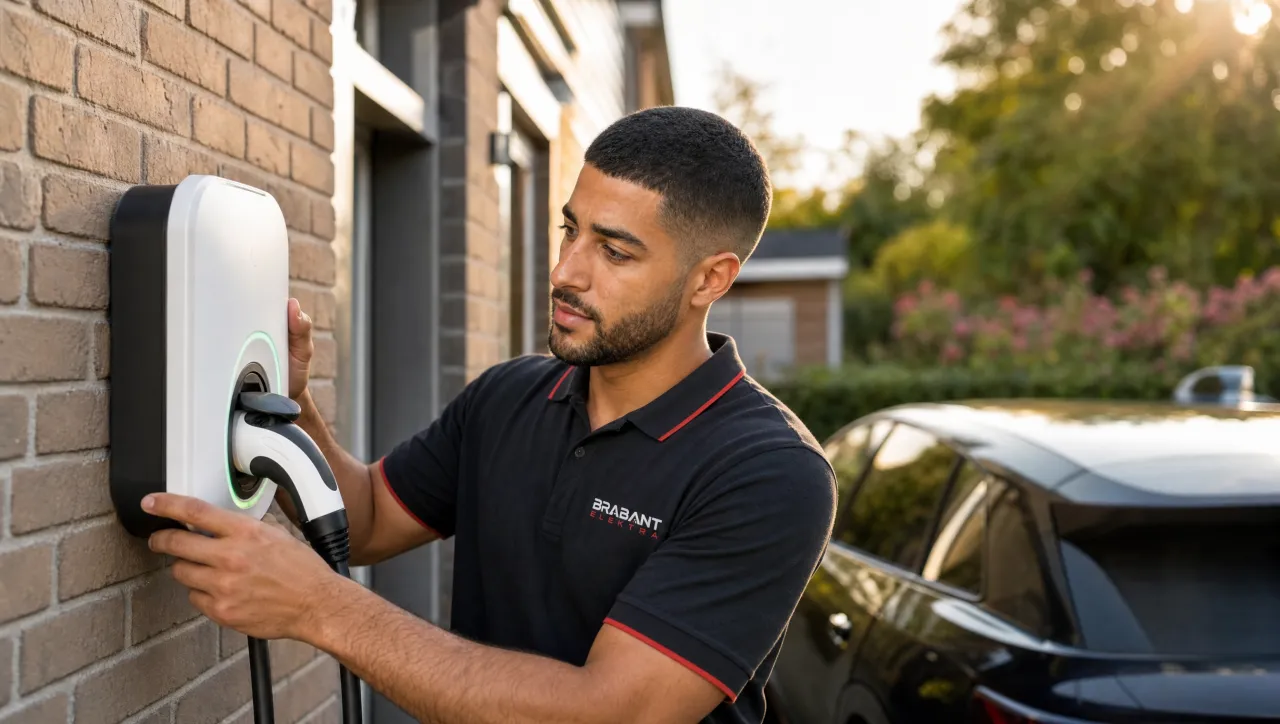
We install your EV charger to NEN 1010: on its own circuit, with the correct RCD protection and neatly routed cabling. We check in advance whether your fuse box and supply are up to it, and give honest advice on what you need. Installing an EV charger yourself is not permitted; it must be done by a certified electrician.
Warning signs
What matters in your situation
Every home and every car is different. These points determine how we install your EV charger.
Single or three-phase
Single-phase charges up to around 7.4 kW, enough for everyday use. If you want to charge faster, towards 11 kW, three-phase is needed. We give honest advice on what suits you.
A dedicated circuit
An EV charger always gets its own dedicated circuit with its own protection. This means it charges safely without taking down the rest of your home.
Distance and cable run
The distance to your meter cabinet and the cable route, inside, along the wall or under the driveway, determine a large part of the work.
Smart charging (load balancing)
With dynamic load balancing, the charger reduces its power when the home is busy. This prevents the main fuse from tripping and sometimes avoids a costly supply upgrade.
Wallbox or freestanding post
A wallbox mounts on the wall; a freestanding post stands on your property. A freestanding post requires a foundation and some groundwork.
Charging on your own solar power
Do you have solar panels? A smart charger prioritises your own surplus. With the net-metering scheme ending, self-consumption is becoming increasingly worthwhile.
How we work
How we approach it
From survey to first charge: neatly and safely sorted.
- 1
Survey and advice
We look at the distance to your meter cabinet, the cable route and the capacity of your fuse box and supply. You get honest advice on power and single or three-phase.
- 2
Fixed price upfront
You receive a clear quote with a fixed price, including everything that comes with it. No surprises afterwards.
- 3
Professional installation
We fit the EV charger or wallbox on a dedicated circuit, with the right RCD protection and neat cabling. Inside, along the wall or underground.
- 4
Testing and configuration
We test the protection, set up single or three-phase and load balancing, and pair the app. Then you are ready to charge, with a 2-year work guarantee.
Good to know
The technical side, in plain English
Two things that often come up with a home EV charger. We explain them calmly.
How fast does a home EV charger charge?
It depends on the power. At 3.7 kW (single-phase) you add around 20 km per hour; at 7.4 kW around 39 km; and at 11 kW (three-phase) about 58 km per hour. A 60 kWh battery is full in about 5.5 hours at 11 kW, and around 16 hours at 3.7 kW.
For everyday use you usually only top up what you have driven that day. Single-phase is often more than enough for that. If you drive a lot or have a large battery, 11 kW on three-phase is more comfortable.
Type A or type B RCD protection?
An EV charger can generate a smooth DC leakage current. NEN 1010 requires this leakage current to be switched off above 6 mA. That can be done with a type B RCD, or with a type A plus an EV charger that has built-in 6 mA detection.
If the charger has that detection built in, a type A RCD is sufficient and you avoid the cost of a separate type B. We check the documentation for your charger and choose the correct, safe protection.
How fast can you charge at home?
What you add depends on the power. For reference, at an average consumption of about 19 kWh per 100 km:
| Power | Range added per hour | 60 kWh battery full |
|---|---|---|
| 2.3 kW (socket) | ± 12 km | ± 26 h |
| 3.7 kW (single-phase) | ± 20 km | ± 16 h |
| 7.4 kW (single-phase) | ± 39 km | ± 8 h |
| 11 kW (three-phase) | ± 58 km | ± 5.5 h |
| 22 kW (three-phase) | ± 116 km | ± 2.7 h |
Indicative values, excluding charging losses. Above 80% the car often regulates the power down itself.
Price
What does an EV charger with installation cost?
The price consists of the charger itself and the installation. What the installation costs depends mainly on the distance to your meter cabinet, the cable run and whether your fuse box or supply needs adjusting. We look first, then give you a fixed price upfront. Below is an indication.
Common extras:
- A dedicated circuit in the fuse box, if no space is available
- Type B RCD protection, if the charger lacks built-in 6 mA detection
- Load balancing for smart charging management
- Upgrade to three-phase, via the grid operator
Price guide
Fixed price upfront| EV charger or wallbox, single-phase (3.7 to 7.4 kW) | € 500 to € 1,200 |
| EV charger or wallbox, three-phase (11 to 22 kW) | € 1,000 to € 2,500 |
| Installation, depending on distance and cable run | from € 350 |
| Groundwork for a freestanding post | ± € 45 per metre |
| Home EV charger, including standard installation | € 1,300 to € 1,800 |
Indicative prices incl. VAT. You will always receive a tailored quote.
Related services
Often done together
An EV charger is linked to your fuse box and supply. These jobs sometimes come with it.
Upgrade to three-phase
Want to charge at 11 kW but have single-phase? We upgrade your supply to three-phase.
More infoReplace the fuse box
No room or capacity for a dedicated charging circuit? We replace or expand your fuse box.
More infoConnect solar panels
Charging on your own solar power? We also handle the connection of your panels.
More infoHome battery
Store your solar surplus and charge your car with it later? We connect your home battery safely.
More infoWhy Brabant Elektra
Certified, insured and guaranteed
All our engineers are qualified and work to the NEN 1010 standard. We give a 2-year guarantee on all our work. Reliable work you can count on.

Frequently asked questions
Good to know
Service area
EV charger installation in Noord-Brabant
More and more people in Brabant are driving electric, from the new-build estates around Eindhoven and Den Bosch to the villages around them. We know the region and install your EV charger at your door, whether it is a wallbox on the wall or a freestanding post on the driveway.
If your supply is still single-phase and you want to charge on three-phase, we arrange the upgrade with grid operator Enexis. Because there can be a waiting time for that, we look into it in good time so your EV charger is ready when you need it.
Service area
Across Noord-Brabant
From major cities to smaller towns, active in:
Ready to have this job done professionally?
Request a free quote or call an electrician near you directly. You will always get a fixed price upfront.
Request a free quote
Response within 24 hours · no obligation
Step 1 of 3
Emergency? Call now
For emergencies, calling is the quickest way to get help. A technician is ready for you.
Call 085 - 060 12 34Thank you, request received!
We will call you back within 24 hours.