About this job
What is a home battery, and how does it work?
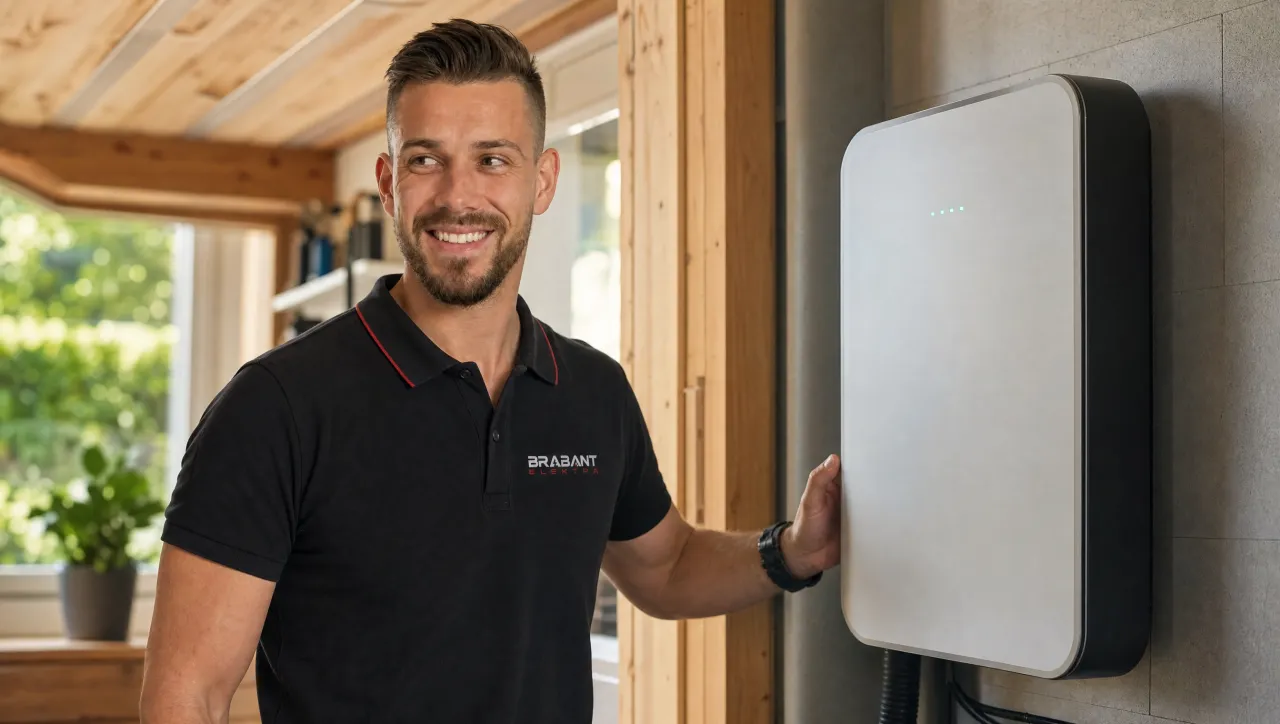
A home battery stores electricity so you can use it at a later moment. Usually to hold on to solar power you generate during the day but do not immediately use, so you can use it in the evening or overnight rather than feeding it back to the grid. Your solar panels and the battery cells run on direct current (DC), while your home and the grid run on alternating current (AC, 230 volts). An inverter converts between the two.
A home battery is not a miracle of efficiency, and we will tell you that plainly. Of the power you put into the battery, around 85% comes back out after a full charge and discharge cycle; the rest is lost, mainly in the inverter. And not every stated kWh is usable: typically 75 to 90% is actually available, because a reserve is kept to prevent deep discharge. A 10 kWh battery often delivers 7.5 to 9 kWh usable. A smart battery decides for itself when charging and discharging makes sense, based on your consumption, the weather forecast and energy prices.
Warning signs
When does a home battery become worth it?
A home battery is not a must. At these moments it becomes worth considering. We name them as an honest assessment, not as a sales pitch.
You use little of your solar power yourself
On average, households use only around 30% of their generation directly. The rest goes to the grid. With storage you use a larger share yourself.
You pay export charges
Many energy suppliers charge export fees that are almost as high as the rate they pay you. That leaves little value in feeding back to the grid, making storage more attractive.
Net metering ends in 2027
Until 31 December 2026 you can still offset in full. After that, using your own generation, and therefore storing it, becomes more financially attractive than feeding it to the grid.
You have a dynamic energy contract
With a dynamic energy contract you charge the battery when prices are low and use it when power is expensive. That works even without solar panels.
Your home is going heavily electric
A heat pump, induction hob or an electric car: the more you run on electricity, the more you benefit from your own storage. Often combined with an EV charger.
You want backup power for outages
Some systems can power part of your home during a grid outage. Note: not every battery can do this, and it usually requires three-phase power and a gateway. Ask about it before you buy.
How we work
How we approach it
From honest advice to a tested installation: clear, safe and without sales pressure.
- 1
Survey and honest advice
We look at your consumption, your generation, your meter cabinet and the location for the battery. You receive honest advice on capacity, AC or DC coupling and whether storage really makes sense for you.
- 2
Fixed price upfront
You receive a clear quote with a fixed price, including inverter, installation and configuration. No hard sell, no surprises afterwards.
- 3
Safe installation
We place the battery in a cool, ventilated spot and connect it in accordance with NEN 1010. Neatly finished, with the right protection in your fuse box.
- 4
Testing, registration and handover
We test the installation, configure the smart control and register the battery on energieleveren.nl. Then we hand it over, with a 2-year work guarantee.
DIY?
Can you install a home battery yourself?
Placing the battery and connecting it to your meter cabinet is work for a certified installer, in accordance with NEN 1010. It involves high currents, the right protection and correct registration. You can do the preparation yourself.
What you can do yourself
- Choose the location: cool, dry and ventilated
- Think about the capacity and your consumption
- Compare quotes and ask questions
What to leave to a certified electrician
- The connection to the fuse box and inverter
- The protection and phase distribution
- The registration with the grid operator
Good to know
The technical side, in plain language
A few things that often raise questions about a home battery. We explain them calmly and honestly.
How does a home battery work: AC or DC coupling?
In a DC-coupled system your solar power goes via one hybrid inverter directly to the battery, with fewer conversion steps and generally slightly higher efficiency. In an AC-coupled system your existing solar inverter stays in place and a separate battery inverter is added. That is cheaper and less disruptive with an existing installation.
The rule of thumb: for a new installation, or if your inverter is due for replacement anyway, DC coupling is often the more logical choice. If your inverter is still working well, AC coupling is usually the sensible option. Most home batteries use LFP cells (lithium iron phosphate): thermally stable, safe and with a long service life of roughly 2,000 to 5,000 cycles.
Single-phase or three-phase: do I need a heavier connection?
Small batteries under around 5 kWh can often work on a single-phase connection, which delivers a maximum of roughly 3.7 kW via a standard circuit. For most systems of 5 to 20 kWh, for high charge and discharge power and for backup power covering a large part of your home, three-phase (3x25A, up to around 11 kW) is strongly recommended or required. A three-phase battery with a three-phase inverter will not work on a single-phase connection.
According to Zonneplan, around 80% of meter cabinets are already suitable. If you do need to upgrade from single to three-phase, the grid operator upgrades the connection after an application via Mijnaansluiting.nl. Allow a few weeks to several months of waiting time. For the details we refer you to our meter box upgrade page.
Is a home battery worth it in 2026?
Honest answer: usually not with certainty. While net metering is still running until the end of 2026, a battery rarely delivers savings that justify the purchase. Milieu Centraal and the Consumentenbond conclude that the payback period is often long and uncertain, sometimes close to or longer than the battery's service life. It is often wiser to first shift your consumption to sunny hours and invest in insulation.
After net metering ends on 1 January 2027, using your own power becomes more attractive and the payback period will fall. Estimates vary broadly: roughly 6 to 10 years for a household with solar panels and a well-sized system, potentially shorter (4 to 6 years) with a dynamic contract and smart control, and 10 years or more in less favourable situations. We would rather work through the numbers honestly with you than promise savings that may not materialise.
Capacity and guide price by size
What suits you depends on your consumption and generation. For orientation, the common sizes with an indication of usable storage and guide price. The stated kWh is not fully usable, as a reserve is kept.
| Capacity | Usable (indicative) | Guide price incl. VAT and installation |
|---|---|---|
| 5 kWh | approx. 4 to 4.5 kWh | € 4,000 to € 6,000 |
| 10 kWh | approx. 7.5 to 9 kWh | € 6,000 to € 8,500 |
| 15 kWh | approx. 12 to 13 kWh | € 8,500 to € 10,500 |
| 20 kWh | approx. 16 to 18 kWh | € 10,000 to € 12,500 |
Indicative guide prices, roughly € 500 to € 1,000 per kWh of usable storage. Prices vary by brand and situation and may rise in 2026. We give you a fixed price upfront via a quote.
Price
What does a home battery cost?
The price depends on the capacity, the brand, AC or DC coupling, whether backup power is needed and whether your connection needs upgrading. That is why we have a look first and then give you a fixed price upfront via a quote. Below is an indication.
Common extras:
- Adapting the meter cabinet or fuse box for the battery circuit
- Backup power function with gateway, for power during a grid outage
- Three-phase inverter for high charge and discharge power
- Smart control with energy management and a dynamic contract
Price guide
Fixed price upfront| Home battery 5 kWh, incl. inverter and installation | € 4,000 to € 6,000 |
| Home battery 10 kWh, incl. inverter and installation | € 6,000 to € 8,500 |
| Home battery 15 kWh, incl. inverter and installation | € 8,500 to € 10,500 |
| Per kWh of usable storage (indicative) | € 500 to € 1,000 |
| Three-phase connection upgrade (if needed, via grid operator) | € 275 to € 450 |
Indicative prices incl. VAT. You will always receive a tailored quote.
Related services
Often done together
A home battery is closely linked to your generation and your connection. These services often go with it.
Connect solar panels
Generation, net metering and feeding back to the grid: the foundation under your battery. We take care of the connection of your panels.
More infoUpgrade to three-phase
Most batteries of 5 kWh and above require three-phase power. We arrange the upgrade with the grid operator.
More infoHome EV charger installation
Want to use surplus solar to charge your car? We match your EV charger and battery to work together.
More infoReplace the inverter
Is your inverter due for replacement? A hybrid inverter with a DC-coupled battery is often the logical next step.
More infoWhy Brabant Elektra
Certified, insured and guaranteed
All our engineers are qualified and work to the NEN 1010 standard. We give a 2-year guarantee on all our work. Reliable work you can count on.

Frequently asked questions
Good to know
Service area
Home battery installation in Noord-Brabant
Brabant is in the middle of the energy transition. More and more homes are getting solar panels, EV chargers or heat pumps, and that is exactly when the question of storage comes up. At the same time the grid is congested in many areas. A home battery does not solve that congestion, but it can help locally by buffering the peak output from your panels, so your inverter switches itself off less readily on sunny days.
We know the region and work together with grid operator Enexis. If an upgrade to three-phase is needed, we account for the waiting times involved and submit the application in good time. That way your installation is safe and future-proof, from Eindhoven to Breda.
Service area
Across Noord-Brabant
From major cities to smaller towns, active in:
Ready to have this job done professionally?
Request a free quote or call an electrician near you directly. You will always get a fixed price upfront.
Request a free quote
Response within 24 hours · no obligation
Step 1 of 3
Emergency? Call now
For emergencies, calling is the quickest way to get help. A technician is ready for you.
Call 085 - 060 12 34Thank you, request received!
We will call you back within 24 hours.